
Sigmar Polke
Baumhaus
1976

Romain Van Wissen
Descendu ici pour les vacances
2018
122 x 100 cm
acrylic on canvas

Romain Van Wissen (BE)
Se remettre d'aplomb
2018
122 x 104 cm
acrylic on canvas
Sigmar Polke
Baumhaus
1976
Romain Van Wissen
Descendu ici pour les vacances
2018
122 x 100 cm
acrylic on canvas
Romain Van Wissen (BE)
Se remettre d'aplomb
2018
122 x 104 cm
acrylic on canvas

Pieter Jansz. Saenredam
Interieur van de Sint-Odulphuskerk in Assendelft
1649
oilpaint on panel
49,6 × 75 cm

Pieter Jansz. Saenredam
Het oude stadhuis in Amsterdam
1657
oilpaint on panel
65,5 × 84,5 cm
When I was at the Rietveld Academy I wanted to become Jackson Pollock, or Willem de Kooning. Abstract, virtuoso and expressive. That way of painting also had many similarities with the guitar music of Jimi Hendrix, another childhood hero of mine. Later I discovered that abstract art was not for me. I started painting reality and worked more cerebral. I became fascinated by art from the Middle Ages, but also by Saenredam, a great master from the 17th century. His interior paintings are created by observing endlessly. The drawings he made while visiting a building were sometimes only converted into paintings decades later. Only then did he also apply modification, for the benefit of the composition or other qualities of the final image.
That's how he mainly painted in his head and I recognize that well, although he was of course a much greater artist than I will ever be. The calm and tranquility in his painted spaces is beautiful, it is overwhelmingly quiet. The light often radiates from behind, as if the painting itself illuminates the actual space where you are as a viewer.
Toon Berghahn, 2024

Toon Berghahn
Jacobs ladder
2024
mixed media on wood
104 x 62 cm

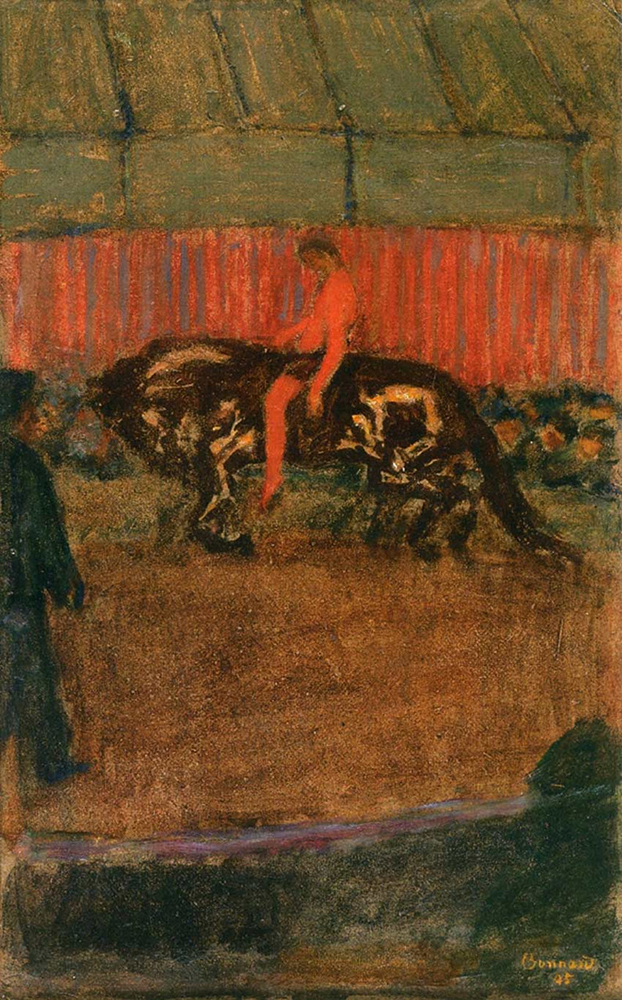
Pierre Bonnard
On the track
1895
oilpaint on panel
42,3 x 27,5 cm

Pierre Bonnard
The Bath
1925
oilpaint on canvas
86 x 120,6 cm
The paintings of Pierre Bonnard often feel timeless for me; showing human life and love has always been the same.
Painted with bold strokes and emotionally lively colors the paintings give a feeling of childlike appreciation and at the same time a strange lifelessness.
Ema Vaneková, 2024

Ema Vaneková
Spolu Zima
2024
oilpaint on linen
40 x 60 cm
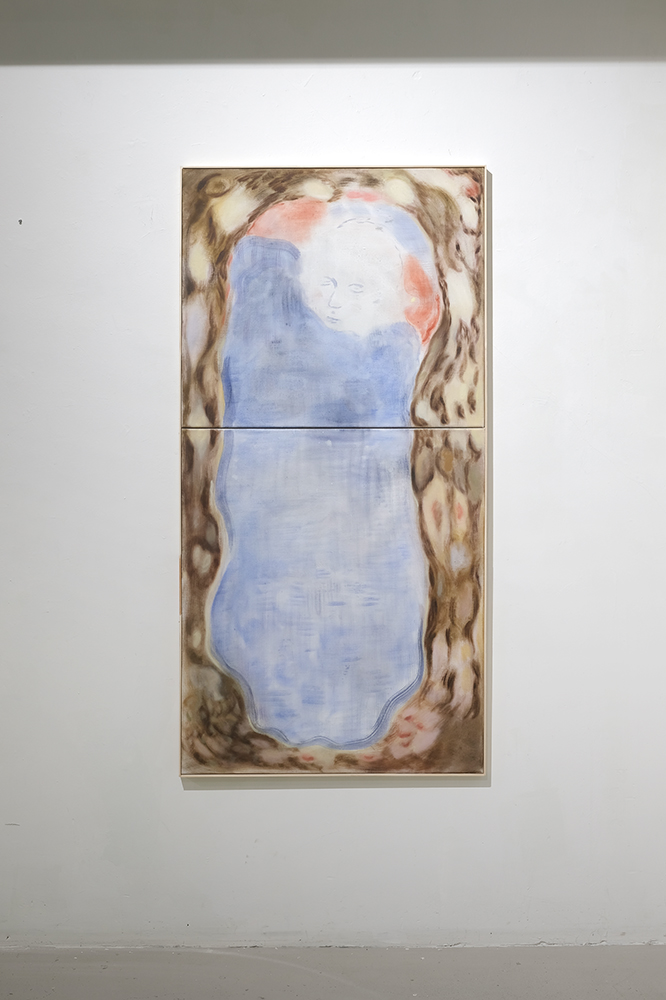

Michel Majerus
10 bears masturbating in 10 boxes
1992
295,3 x 560,6 cm
acrylic on canvas

Michel Majerus
lost forever
1992
280 x 400 cm
acrylic on canvas
Majerus like
Not the worst comparison I thought when I read the comment under one of my Instagram posts. Majerus has a lot that drives me to make paintings. His curiosity towards the environments and his enthusiasm to be aware of changes in the world that directly flooded into his art. By applying various techniques and mixing different influences he developed a signature style with different characteristics where none is taking precedence over the other. In his paintings, an expressive brushwork has the same value as a comic character, there is no high and low.
He didn‘t accept boundaries, his work is catchy and he was in the here and now... but even as I write this, I‘m wondering whether exactly the opposite might be desirable sometimes. Majerus works appear as if they are entirely dedicated to postpop, the aesthetics of advertising, video games and consumerism. And it can be seen as if he just celebrated this flat aesthetics and built them a memorial. Or not? “What looks good today may not look good tomorrow,” one of his paintings shows him as a doubter. His works, which appear so self-confident, are perhaps a criticism of consumption and our enthusiasm for media.
Often the work seems to be unfinished, parts are overpainted and the surface is kind of damaged. Scratches on the glossy world of the computer screen. Doubt and Enthusiasm? Is there only black and white? Or is there a wide variety of shades of grey? Maybe he simply quoted and painted things that excited him without evaluating them in advance.
I feel very close to him, painting what interests me, what excites me and what I simply want to paint. And it shouldn‘t matter whether this already exists, whether someone else has already done it or whether someone says that you shouldn‘t paint it.
Michael Weißköppel, 2023

Michael Weißköppel
Didn't
2023
120 x 170 cm
acrylic and acrylic spray paint on canvas

Michael Weißköppel
Mirrors
2023
160 x 240 cm
acrylic and acrylic spray paint on canvas

Michael Weißköppel (DE)
GOO
2022
160 x 240 cm
acrylic and acrylic spray paint on canvas

Odilon Redon
The Dream
1904
oil on canvas
private collection

Odilon Redon
Roger and Angelica
1910
pastel on paper on canvas
92,7 x 73 cm

Odilon Redon
Trees on a yellow background
1901
oil, tempera, charcoal, pastel on canvas
247 x 173 cm
Musée d’Orsay
"I have always felt the need to copy small, accidental objects from nature. Only after I have gone to great lengths to faithfully reproduce a blade of grass, a branch or an old wall do I suddenly feel that I need to create something from my imagination. This is how nature becomes my source of inspiration."
“Every stroke of the brush, every line drawn, is an invitation into a world of infinite possibilities, where anything can happen”
“To create is to delve into the unknown, to embrace the uncertainty and embrace the chaos. It is this journey that art finds its truest form.”
Odilon Redon
Landscapes that are constantly changing through time, the influence of the weather and the intervention of man, forms the breeding ground for my visual work. The cycle of budding, growth and flowering, decay, dying and sprouting again determines the difference in forms, colours and atmosphere so characteristic of these different stages. This natural process, the rhythm of change, repetition or continuous progression, is also taking place within ourselves, something we tend to forget.
In the last few years my work has been shifting from exploring the visual world outside to the visual world inside as well. The connection between nature and me is a never-ending exploration, as I am part of it.
I feel a similarity between Redon's work and my own. He too often started from an observation of nature. It is precisely his way of working that creates a dimension beyond reality. The work is ambiguous and has something intangible.
Lydia Scheurleer, 2023

Lydia Scheurleer
High Tide 5
2021
Pen-bé series
handmade print, watercolour, pastel on craftliner
102 x 72 cm

Lydia Scheurleer
De Poel 11
2023
handmade print, marker, acrylic on canvas
30 x 24 cm

Lydia Scheurleer (NL)
'Pulse' Brainscape
2023
handmade print, conté, watercolour on paper
42 x 29,7 cm

Gordon Matta-Clark
Office Baroque: photographic documentation_24 Interior view
1977
Wandering through my bookshelves it was hard to choose an artwork. With just as much enthusiasm I could have chosen the work of Jan Schoonhoven, Gunther Eucker or Yves Klein, but the installation Office Baroque (1977) by Gordon Matta-Clark unites all different aspects of my recent work.
https://www.muhka.be/nl/collections/artworks/o/item/4270-office-baroque-photographic-documentation
I became fascinated by architectural concepts during my studies at the art academy where I was first introduced to the work of Matta-Clark. In addition, I have a great love for archeology and geology, discovering the earth by digging and drilling within a framework, uncovering matter layer by layer. Through perforation, layers appear and disappear. All of this is ultimately brought together in a powerful minimal image.
Mark Kramer, 2023
,%2023,5%20x%2029%20cm,%202022%20ok.jpg)
Mark Kramer
Platenatlas (1963)
2022
23,5 x 29 cm
perforated atlas, glue, acrylpaint
%20%202022,%20detail%20ok.jpg)
Mark Kramer
Platenatlas (1963)
detail

Mark Kramer
studiowall 2022
%2024%20x32%20cm,2022%20ok.jpg)
Mark Kramer
Kleine atlas der gehele aarde (1961)
2022
24 x 32 cm
perforated atlas, glue, acrylpaint

Mark Kramer
layers of perforated paper
studio 2022
,%202021%20work%20in%20progress%20detail%20ok.jpg)

Carmen Herrera
at work

Carmen Herrera
Verde que te quiero verde (Green How I Desire You Green)
2020
large-scale mural
Blanton Museum of Art, Austin, Texas
I only discovered Carmen Herrera's work in 2018, in a major exhibition of her work at Kunstsammlung NRW in Düsseldorf. She died last year at the age of 106. Until the end, she worked on new work every day in her flat with ruler and compasses. Herrera, born in Cuba in 1915, had to wait her whole life for her work to be recognised. At the age of 89, she sold her first work.
In 2018, Whitney Museum finally picked up her work. The actions of Guerilla Girls (https://www.guerrillagirls.com/) who have been fighting for years for gender and ethical equality in the art world, are vital, still today! Herrera was simultaneously working on her oeuvre alongside Barnett Newman (family friend), Ellsworth Kelly (her neighbour) and Frank Stella. Her work was ignored because she was a woman and her Latin American background did not help either.
In Herrera's work, colour and the straight line are the protagonists. I admire her precisely for that focus on the square millimetre where she spends a lifetime digging into the depths. What limitation and concentration!
Colour is also one of the great loves in my work. Unlike the colourfield painters like Herrera and my other great love Ellsworth Kelly, in my work nothing is tight and straight, but the lines and pools of colour move with me, bending, snapping and digesting with the life of plants. Like a logbook, I record the seasons from my tiny city garden in metres high watercolours.
Painting is something that flows in all directions, from being in the middle of a work seeing what emerges around me. I am always in direct connection with my surroundings. Everyone is welcome in my work. Starting from painting, I work on an ever-growing community embroidery project 'Let's grow flowers not walls' with people from all corners of the world (to be seen next summer in Centraal Museum Utrecht), on De Stiltetuin with plant meditations, on setting out flower bombs with 40 school classes. The antique Persian garden carpet, a sleek geometric carpet representing the four cardinal points, is a starting point.
From that love of geometry, Carmen Herrera's work touches me very much. It is complementary and therefore strongly related.
'Verde que te quiero verde', meaning 'Green How I Desire You Green'; what a title. A mural she realised in 2021 as a 105-year-old for the Blanton Museum of Art at the University of Texas in Austin. Or 'More yellow, less green'. In the sleek, formal oeuvre of Herrera who also loves the large format, they are almost incantations, phrases you say to yourself when you are at work. The physical desire for colour as a command for the work. I recognise that and it inspires me enormously.
But most of all, I am captivated by Herrera's attitude. As a fresh graduate in the late 1980s, I heard that a career in art was not possible if you also aspired to motherhood. And perhaps also because I took my career firmly in hand myself, not waiting for galleries, museums and funds. 'My love of the line is what drives me,' Herrara says.
'You have to wait for the bus, it will always come. I had to wait for 98 years but it came!'
Jolanda Schouten, 22 October 2023

Jolanda Schouten
in the studio
photo Lize Kraan

Jolanda Schouten
01032022
2022
490 x 350 cm
watercolour, adhesive tape on Thai bamboo paper
exhibition 'AQUAVIT, about contemporary watercolour'
Cacaofabriek Helmond NL (2022)
photo Biek van Bree

