Saturday, 4 November 2023

Mark Kramer / Gordon Matta-Clark


Gordon Matta-Clark

Office Baroque: photographic documentation_24 Interior view

1977


Wandering through my bookshelves it was hard to choose an artwork. With just as much enthusiasm I could have chosen the work of Jan Schoonhoven, Gunther Eucker or Yves Klein, but the installation Office Baroque (1977) by Gordon Matta-Clark unites all different aspects of my recent work. 

https://www.muhka.be/nl/collections/artworks/o/item/4270-office-baroque-photographic-documentation
I became fascinated by architectural concepts during my studies at the art academy where I was first introduced to the work of Matta-Clark. In addition, I have a great love for archeology and geology, discovering the earth by digging and drilling within a framework, uncovering matter layer by layer. Through perforation, layers appear and disappear. All of this is ultimately brought together in a powerful minimal image. 


Mark Kramer, 2023


Mark Kramer

Platenatlas (1963)

2022

23,5 x 29 cm

perforated atlas, glue, acrylpaint


Mark Kramer

Platenatlas (1963)

detail


Mark Kramer

studiowall 2022


Mark Kramer

Kleine atlas der gehele aarde (1961)

2022

24 x 32 cm

perforated atlas, glue, acrylpaint


Mark Kramer

layers of perforated paper

studio 2022


Mark Kramer (NL)

Kleine atlas der gehele aarde (1963)

2021

work in progress, detail 

www.markkramer.nl


Monday, 23 October 2023

Jolanda Schouten / Carmen Herrera


Carmen Herrera 

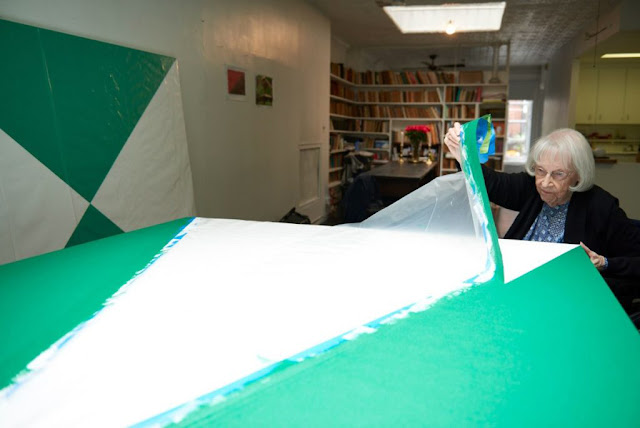
at work


Carmen Herrera 

Verde que te quiero verde (Green How I Desire You Green)

2020

large-scale mural

Blanton Museum of Art, Austin, Texas


I only discovered Carmen Herrera's work in 2018, in a major exhibition of her work at Kunstsammlung NRW in Düsseldorf. She died last year at the age of 106. Until the end, she worked on new work every day in her flat with ruler and compasses. Herrera, born in Cuba in 1915, had to wait her whole life for her work to be recognised. At the age of 89, she sold her first work. 

In 2018, Whitney Museum finally picked up her work. The actions of Guerilla Girls (https://www.guerrillagirls.com/) who have been fighting for years for gender and ethical equality in the art world, are vital, still today! Herrera was simultaneously working on her oeuvre alongside Barnett Newman (family friend), Ellsworth Kelly (her neighbour) and Frank Stella. Her work was ignored because she was a woman and her Latin American background did not help either.


In Herrera's work, colour and the straight line are the protagonists. I admire her precisely for that focus on the square millimetre where she spends a lifetime digging into the depths. What limitation and concentration! 

Colour is also one of the great loves in my work. Unlike the colourfield painters like Herrera and my other great love Ellsworth Kelly, in my work nothing is tight and straight, but the lines and pools of colour move with me, bending, snapping and digesting with the life of plants. Like a logbook, I record the seasons from my tiny city garden in metres high watercolours.

Painting is something that flows in all directions, from being in the middle of a work seeing what emerges around me. I am always in direct connection with my surroundings. Everyone is welcome in my work. Starting from painting, I work on an ever-growing community embroidery project 'Let's grow flowers not walls' with people from all corners of the world (to be seen next summer in Centraal Museum Utrecht), on De Stiltetuin with plant meditations, on setting out flower bombs with 40 school classes. The antique Persian garden carpet, a sleek geometric carpet representing the four cardinal points, is a starting point. 

From that love of geometry, Carmen Herrera's work touches me very much. It is complementary and therefore strongly related.


'Verde que te quiero verde', meaning 'Green How I Desire You Green'; what a title. A mural she realised in 2021 as a 105-year-old for the Blanton Museum of Art at the University of Texas in Austin. Or 'More yellow, less green'. In the sleek, formal oeuvre of Herrera who also loves the large format, they are almost incantations, phrases you say to yourself when you are at work. The physical desire for colour as a command for the work. I recognise that and it inspires me enormously.

But most of all, I am captivated by Herrera's attitude. As a fresh graduate in the late 1980s, I heard that a career in art was not possible if you also aspired to motherhood. And perhaps also because I took my career firmly in hand myself, not waiting for galleries, museums and funds. 'My love of the line is what drives me,' Herrara says. 


'You have to wait for the bus, it will always come. I had to wait for 98 years but it came!'


Jolanda Schouten, 22 October 2023


Jolanda Schouten

in the studio

photo Lize Kraan


Jolanda Schouten

01032022

2022

490 x 350 cm

watercolour, adhesive tape on Thai bamboo paper

exhibition 'AQUAVIT, about contemporary watercolour'

Cacaofabriek Helmond NL (2022)

photo Biek van Bree


Jolanda Schouten (NL)

in the studio

photo Lize Kraan

www.jolandaschouten.nl


Sunday, 17 September 2023

Jenetta de Konink / Louise Bourgeois


Louise Bourgeois

Single 11

1996

fabric, hanging piece

203 x 107 x 76 cm


Jenetta de Konink (NL)

Serie SL - Jurk

2020

oil/embroidery on canvas

50 x 40 cm

www.jenettadekonink.nl


Saturday, 26 August 2023

Judith Krebbekx / Paula Rego


Paula Rego

The dance

1988

acrylic on paper on canvas

213 x 274 cm


Paula Rego

Three blind mice

1989

etching

22,6  x 21,2 cm


In 2007 I visited Lisbon for the first time and there I saw Paula Rego´s paintings. Her artworks slapped me in the face. They were dark, honest and almost terrifying. She dared to make extremely personal art. She literally painted her fears, her angers and grieves.

In my former art education we had been told not to tell stories, for stories were for writers. And there she was, not afraid to tell her story to the world. 

If art, in any form, dares to be about inner thoughts, it transcends the personal and thus can be recognized by anyone, as we all have these thoughts, these fears, that accompany us in our lives and visit us in our dreams. 


Judith Krebbekx, 2023


Judith Krebbekx

Don Juan's reckless daughter

2023

acrylic and charcoal on linen

200 x 180 cm


Judith Krebbekx (NL)

Fool to cry

2023

acrylic and charcoal on linen

100 x 100 cm

www.judithkrebbekx.com


Saturday, 12 August 2023

Ossip / Many Sources


Lucian Freud

Benefits Supervisor Resting

1994

150 x 161 cm 

oil on canvas

image in catalogue Kunsthistorisches Museum Wien 


I don't have a model artist...before maybe...Paul Klee, Miro, but never with specific work. I am very idiosyncratic and self-taught in that respect....I use all kinds of books, pictures, images...very intuitively chosen. The sources are not preconceived....

In this case, an image of a work by Lucian Freud is the source for a work of my own.


Ossip, 2023


Ossip (NL)

K A L F

2015

52 × 56 cm

mixed media

www.ossip-artist.com


Saturday, 8 July 2023

Koen Delaere / Lawrence Carroll


Lawrence Carroll

Youth
2008

oil, wax and canvas on wood

211 x 158 cm


Koen Delaere (NL)

Stereographic/Field On Field

2022

pigments, ink, oil paint medium and acrylic medium on linen 

250 x 175 cm

www.jensengallery.com/koen-delaere


Saturday, 24 June 2023

Emma Peters / Frankenthaler-Newman-Hill


Helen Frankenthaler

Buddha’s Court
1964
acrylic on canvas
249 cm x 239 cm
private collection Mr. and Mrs. Robert K. Hoffman


I got acquainted with Helen Frankenthaler as an art student. I had been messing around with other media for a while then, dismissing painting (on canvases especially) as too rigid and antiquated. This painting I’ve only seen in a book thus far, ‘Helen Frankenthaler: a paintings retrospective’, and yet it has enthralled me enough to keep returning to it. It is just shy of a perfect square, with an almost symmetrical layout. There is a rigidity to the work, made lighter by the inherent glow of the blues and oranges which gives it such a mystical character. My own paintings tend to be much more chaotic, but the one thing that this has in common with all of my other favourite works (be it other people’s or my own), is that it seems to hum, be alive. It is a place, a seat. As much as painting has a long, and weighty tradition behind it, there is also such a simplicity to that canvas on the wall. Within those four lines of the edges exists radical freedom. It does not conform to our natural laws of physics, of time passing. It creates its own. She is one of the painters that taught me this very juicy truth. This is indeed Buddha in his court, the painting being both a regal as well as friendly presence. Simple as that. 


Barnet Newman

Cathedra

1951

oil and acrylic on canvas

243 x 543 cm

collection Stedelijk Museum, Amsterdam


Then there is the beloved Cathedra. Without meaning to, here we have another seat. It is linked to the biblical throne of God, and to the connection Newman felt with spirituality creating this work. Newman was not a believer in the traditional sense of the word, and neither am I honestly. I do not believe in god, but I love that feeling you get when looking at the night sky for a little too long. You get swallowed up by the thing above you that’s bigger and older. This work is monumental, it is lofty, and I find myself putting some time aside to visit every time I’m in Amsterdam. It even makes it feel slightly like a pilgrimage, but despite its loftiness I do not feel an arrogance from the work. It invites you to disappear in there for a while, join in the zips present already. There’s an incredible depth to the blue which starts to move, almost vibrate as you close the distance. You see that the blue is glowing, humming, bristling with red. You notice green bruising the space. Creeping up on you, the painting shows you just how dark yellow can get. There’s a comfort to this, to sitting with this thing that is older and does not let itself be understood completely.


Carl Fredrik Hill
Figure Composition
not dated
oil on paper mounted on canvas
49 x 64 cm
collection National Museum, Stockholm


Now to a painting I fell in love with more recently. I had the pleasure of viewing this at the Swedish Ecstacy exhibition in Bozar. Initially I was purely drawn to this exhibition because of Hilma af Klint (another one of my great loves), but, oh, the fun of falling in love with an artist previously unknown to you on top of that. Hill is known for the landscapes he painted in the early years of his career, and for the drawings of fantastical scenes he created after he became mentally ill in his late twenties. There is a great intensity and drive to him, which went unabated in the second part of his career. The strangeness in his works though, already simmering, exploded. Many of his drawings and paintings from that period tickle me in one way or another, but this is simply a work I want to bite, sink my teeth into. It’s so visceral. At the Bozar exhibition it was hung horizontally, and then while looking it up online vertically. I’m still not entirely sure which way is the right way, but both are fun to me. Horizontally it took me a little longer to figure out what was going on in the painting, while vertically? It is a landscape and it is so alive. The writhing bodies are clouds, the cock is a tower and the reclining women are babbling brooks. It touches something that is very dear to my own heart, my own inspiration: the idea of the imaginal being grounded in the material, and the aliveness of it. No either/or, but yes/and. It is such a physical and fresh example of this.


Emma Peters, 2023 


Emma Peters 

Eve’s Eyrie
2021
acrylic on cotton
200 x 300 cm


Emma Peters
Fecund 
2022
acrylic on canvas
100 x 190 cm


Emma Peters (NL)

Untitled
2023
acrylic on canvas
50 x 60 cm

emma-peters.nl