Saturday, 8 August 2015

Jop Vissers Vorstenbosch / Gordon Matta-Clark


Gordon Matta-Clark
Conical Intersect
1975
27-29 Rue Beaubourg, Paris


Jop Vissers Vorstenbosch (NL)
Installation
2013
wood, oil, halogen light
Including:
Oppenheimers grondstoffelijke trillingen
2013
oil, acrylic, lacquer on linen
40 x 55 cm


Saturday, 18 July 2015

Paul Behnke / Stewart Hitch


Stewart Hitch
Schenevus
1982
oil on canvas
91,5 x 76 cm (36 x 30 in)
University of Alaska Museum of the North


Last year I was watching The Mona Lisa Curse (2008) on YouTube. In this documentary, Robert Hughes shows how commerce changed the way we look at art and what art stands for.

In one scene, Hughes was speaking about collectors and a still shot popped up on the screen of Herb and Dorothy Vogel in an artist's studio. 

The artist was nondescript and unassuming (as were the collectors, by the way) but the work struck a nerve. The paintings were large and I was immediately drawn to the scruffy and lopsided “star” shapes surrounded by flat backgrounds that served to lock in and isolate the startling central bursts. 

As a painter, there is little more exciting than discovering an artist that is completely new to you. So I took a screen shot from the video and began a frantic image search to find out more. 

After coming up empty time and time again, I got smart and asked myself who I knew that would be familiar with this painter. I immediately thought of the poet and art critic John Yau, with his extensive knowledge of a New York art world that many have forgotten. Sure enough, he responded to my email with the artist's name: Stewart Hitch!

I quickly learned more about Hitch and his career and feel lucky to have seen a small amount of his work in person. With each viewing or online discovery I began to feel a growing connection with his painting. 

At the time, and for about two years prior, I had been struggling (or struggling not) to find a way to integrate a certain type of imagery - forced through my own non-objective meat grinder- into my work. The imagery kept showing up, unannounced and unwelcome. And as every painter knows, if an element keeps happening despite your best efforts at obliterating it, it's probably time to embrace it and see where it takes you.

In Hitch's work, I had a concrete example of one way of achieving this. I now knew it was possible. Stewart Hitch had done it. It was in the world and his paintings confirmed my desires for my own work.

Other artists I had been aware of, like Nicholas Krushenick and some very early paintings by the British Pop artist Allen Jones, had successfully combined Pop and Op with abstraction. But I saw in Stewart Hitch's work something more, a timeless thing that spoke of a love for and a belief in abstraction and an integration of the pop culture that we drown in everyday. Through the repetition of the  "star" shape, I also felt a sense of the mystic, of a transcendent quality and a bit of the spiritual that I was looking to convey in my own painting. The vague open quality of Hitch's signature, central form allowed for this. And my connection to and discovery of Hitch's work continue to suggest a way for my own paintings to become more integrated and better represent me as a person and a painter.

Paul Behnke, 2015


Paul Behnke (US)
Green Haint
2014
acrylic on canvas
152 x 147 cm (60 x 58 in)


Thursday, 2 July 2015

Dick van Berkum 2 / Fra Angelico-William Hogarth


Fra Angelico
The Cortona Altarpiece (The Annunciation)
1433-34
tempera on wood
175x180 cm


William Hogarth
Illustration from The analysis of beauty, written with a view of fixing the fluctuating ideas of taste
1753


In the summer of 1997 we rented a wing of an aristocratic villa near Sant'Angelo di Cortona, down the mountain on which Cortona is located. At the Museo Diocesano in Cortona I found myself in awe of this miraculous painting by Fra Angelico.
I must have been watching the wonder for at least half an hour. The colors, the shapes, the use of space, the way the perspective was done, the hand of the angel pointing, the hands of the virgin… everything a wonderful joy and celebration of life and its wonders.
I was aquainted since early childhood with reproductions from this painting, but facing it's astonishing beauty was overwhelming.
It haunted me for years.
Six years later I painted "Three Apples". Although there is no direct connection, I would never have painted it without seeing this work by Fra Angelico in person.
Dick van Berkum, 2015


Dick van Berkum (NL)
Three Apples
2003
oil on canvas
200 x 150 cm


Saturday, 20 June 2015

Dick van Berkum 1 / Ad Reinhardt-Gustave Courbet


Ad Reinhardt
Abstract Painting
1963


Gustave Courbet
Autoportrait sous forme d'une pipe
1858
(Courbet, sans idéal et sans religion)


Beside many others Ad Reinhardt "accompanied" me for many years during the 1970ies and 80ies.
I liked his paintings from the 1950ies and early 60ies as well as his cartoons and writings.
In the late years of his life his paintings became black: “no realism, no impressionism, no expressionism… no texture, no brushwork, no sketching or drawing, no forms, no designs, no calm, no light, no space, no time, no size or scale, no movement, no object, no subject.”
A great challenge and opportunity for a new start in my view. My painting from 1993 is a selfportrait. It's me in the studio, watching the change of light and colors on a sunny afternoon.
Dick van Berkum, 2015


Dick van Berkum (NL)
Made in Holland (Sunlight in the Studio)
1993
acrylic, pencil and oil on canvas
140 x 280 cm


Monday, 8 June 2015

Lesley Hicks / Johannes Vermeer


Johannes Vermeer
View of Delft
c.1660-1661
oil on canvas
96,5  x 115,7 cm


‘The View of Delft’ by Vermeer possesses the freshness of sunshine after rain and although it was his hometown, for me it has all the visual excitement of venturing into a place for the very first time.

My watercolour ‘view of Antwerp from south of the river’ was painted with a nod to Vermeer’s great work, during my first walk into that city. The light, skyline and river were too enticing to pass by without recording that particular, never to be repeated moment, a moment of anticipation.

When working out in the open in this way I find the process and urgency of decisions – where to begin – what to leave out - the scale of mark - happen so quickly as to be almost beyond thought.  As instinct kicks in - the accumulation of decisions crystallize into the painting.

Lesley Hicks, 2015


Lesley Hicks (UK)
View of Antwerp from South of the River
2010
watercolour, ink and acrylic on paper
14 x 21 cm


Monday, 25 May 2015

Uwe Poth / Hieronymus Bosch


Hieronymus Bosch
The Tree-Man
ca.1503-1506
pen and brown ink on paper
27,7 x 21,1 cm
Albertina, Vienna


In the centre of the portrait-format sheet, a tree-man rises above a river. His egg-shaped body, covered in part with bark and/or feathers, supports itself on two crooked, partly hollow tree trunks that at the same time resemble arms, and which are standing in boats as if they were shoes. His head, which is turned back over one shoulder towards the viewer, is crowned by a flat disc carrying an enormous jug. They include at least two men and a woman, and one or two other people. A flag with a crescent moon flies from a long slanting pole, recalling an inn sign. Higher up, an owl perches in the leafless crown of the tree that rises skywards from the giant's left foot. The plants motifs in the drawing can be summed up in terms of 'flourishing/living' versus 'dying'. Near a tall, slender tree in the lower left corner a deer is poised on the sloping bank, opposite a stork standing on one leg on the right. Birds are flying around the middle ground and mobbing an owl on the right. In the background, beneath banks of clouds, a harbour with a large number of boats extends along the irregular shoreline, and several villages or small towns are clustered around church spires.
F. Koreny for Albertina Vienna, inv.no. 7876, 1967


Uwe Poth (DE/NL)
Branchings -Vertakkingen–
2008
oilpaint on photocanvas
210 cm x 130 cm


The philosophical tree–man + the 3 graces here and now, in the terrestrial world, connecting the 'higher place' (heaven) and the 'low places' (the underworld). A symbol of the reconciliation from contradistinctions.
Uwe Poth, 2015


Tuesday, 19 May 2015

Maarten van Soest / Paul Cézanne


Paul Cézanne
Mont Sainte-Victoire
ca 1905
oil on canvas
60 x 72 cm


Paul Cézanne was one of the most innovative artists I have ever seen. His own unique style emerged from impressionism, his sensitive touch and beautiful color palette are of a rare quality.
My admiration started at an early age, since the first time I saw his painting 'Mont Sainte-Victoire', ca 1905. This painting had a big impression on me, this was partly because of the amazing colors, but mostly it was the abstraction of the landscape, this was beyond my imagination at that time. The mountain on this painting will become his inspiration and obsession and ultimately his death.

Cézanne painted this when he was 66 years old and he died a year later. He was caught in a storm while he was painting on this mountain. Because of his obsession with paining and this mountain he stayed there to finish the painting, after two hours he decided to go home. On his way back he collapsed and was found hours later, he suffered from hypothermia. The next day he wanted to go back to finish his painting, but half way up the mountain he lost his consciousness. They brought him back to his bed and he never left that bed again. He died a couple of days later.

With the story of his death in the back of my head, it seems to me that Cézanne already painted the storm that would kill him a year later. The dark sky that slowly tries to take over the landscape and wants to swallow the painting. But still there are some sunbeams that cut through the dark sky as if they try to say that there is still a strong force that will try to beat this heavy storm. Unfortunately we know that that force wasn't strong enough.

Years later, when I became a student at the art academy I realized that my own obsession with
abstract art started with this painting by Cézanne. Of course this is still more or less a figurative
painting, but it's far off from being a realistic view of the mountain. Later, after painting merely
pure abstract paintings, I started to incorporate figurative representations of things drawn from the
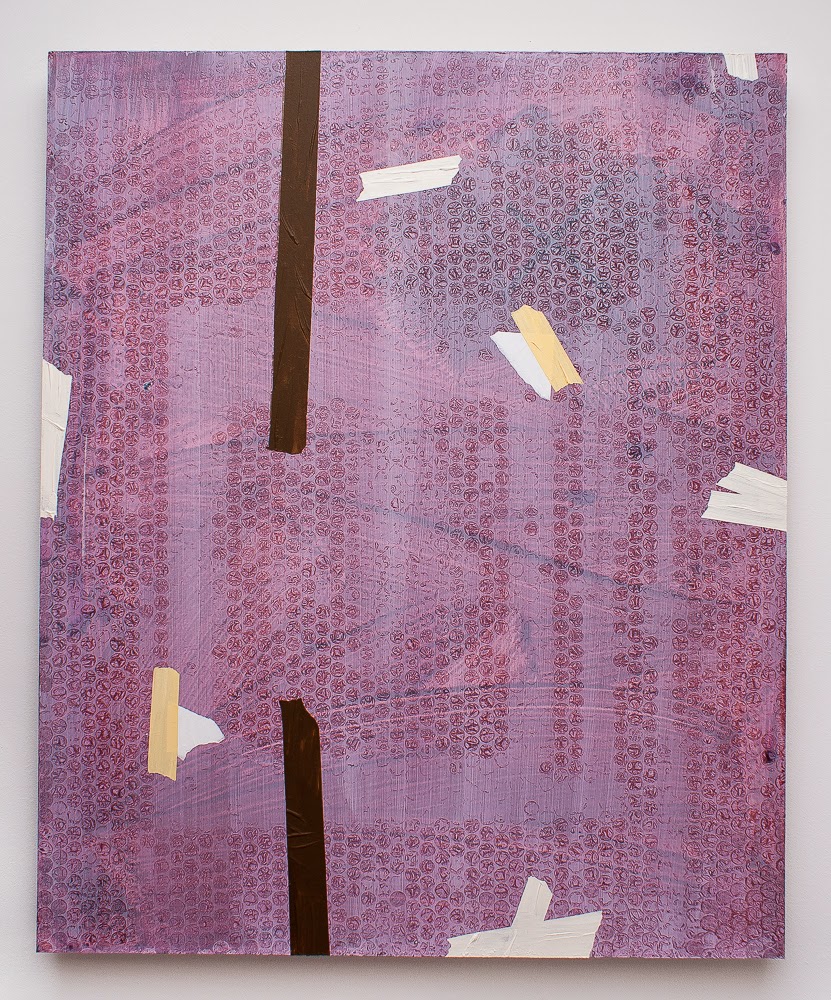
real world, things like tape and bubble-wrap, in order to make abstract paintings that play with the
associative character of the human brain. This is actually the mirror image of what Cézanne did
when he incorporated abstraction in his paintings, trying to come closer to the expreience of what you
see rather than being just another representation of what already exists.
Maarten van Soest, 2015

'I wished to copy nature. I could not. But I was satisfied when I discovered the sun, for instance, could not be reproduced, but only represented by something else'.
Paul Cézanne (1839-1906)


Maarten van Soest (NL)
No Title (Unpacked nr. 6)
2013
acrylic on MDF
60 x 50 cm


Maarten van Soest (NL)
No Title (Sawed nr. 1)
2012
acrylic on MDF
50 x 45 cm