Saturday, 20 June 2015

Dick van Berkum 1 / Ad Reinhardt-Gustave Courbet


Ad Reinhardt
Abstract Painting
1963


Gustave Courbet
Autoportrait sous forme d'une pipe
1858
(Courbet, sans idéal et sans religion)


Beside many others Ad Reinhardt "accompanied" me for many years during the 1970ies and 80ies.
I liked his paintings from the 1950ies and early 60ies as well as his cartoons and writings.
In the late years of his life his paintings became black: “no realism, no impressionism, no expressionism… no texture, no brushwork, no sketching or drawing, no forms, no designs, no calm, no light, no space, no time, no size or scale, no movement, no object, no subject.”
A great challenge and opportunity for a new start in my view. My painting from 1993 is a selfportrait. It's me in the studio, watching the change of light and colors on a sunny afternoon.
Dick van Berkum, 2015


Dick van Berkum (NL)
Made in Holland (Sunlight in the Studio)
1993
acrylic, pencil and oil on canvas
140 x 280 cm


Monday, 8 June 2015

Lesley Hicks / Johannes Vermeer


Johannes Vermeer
View of Delft
c.1660-1661
oil on canvas
96,5  x 115,7 cm


‘The View of Delft’ by Vermeer possesses the freshness of sunshine after rain and although it was his hometown, for me it has all the visual excitement of venturing into a place for the very first time.

My watercolour ‘view of Antwerp from south of the river’ was painted with a nod to Vermeer’s great work, during my first walk into that city. The light, skyline and river were too enticing to pass by without recording that particular, never to be repeated moment, a moment of anticipation.

When working out in the open in this way I find the process and urgency of decisions – where to begin – what to leave out - the scale of mark - happen so quickly as to be almost beyond thought.  As instinct kicks in - the accumulation of decisions crystallize into the painting.

Lesley Hicks, 2015


Lesley Hicks (UK)
View of Antwerp from South of the River
2010
watercolour, ink and acrylic on paper
14 x 21 cm


Monday, 25 May 2015

Uwe Poth / Hieronymus Bosch


Hieronymus Bosch
The Tree-Man
ca.1503-1506
pen and brown ink on paper
27,7 x 21,1 cm
Albertina, Vienna


In the centre of the portrait-format sheet, a tree-man rises above a river. His egg-shaped body, covered in part with bark and/or feathers, supports itself on two crooked, partly hollow tree trunks that at the same time resemble arms, and which are standing in boats as if they were shoes. His head, which is turned back over one shoulder towards the viewer, is crowned by a flat disc carrying an enormous jug. They include at least two men and a woman, and one or two other people. A flag with a crescent moon flies from a long slanting pole, recalling an inn sign. Higher up, an owl perches in the leafless crown of the tree that rises skywards from the giant's left foot. The plants motifs in the drawing can be summed up in terms of 'flourishing/living' versus 'dying'. Near a tall, slender tree in the lower left corner a deer is poised on the sloping bank, opposite a stork standing on one leg on the right. Birds are flying around the middle ground and mobbing an owl on the right. In the background, beneath banks of clouds, a harbour with a large number of boats extends along the irregular shoreline, and several villages or small towns are clustered around church spires.
F. Koreny for Albertina Vienna, inv.no. 7876, 1967


Uwe Poth (DE/NL)
Branchings -Vertakkingen–
2008
oilpaint on photocanvas
210 cm x 130 cm


The philosophical tree–man + the 3 graces here and now, in the terrestrial world, connecting the 'higher place' (heaven) and the 'low places' (the underworld). A symbol of the reconciliation from contradistinctions.
Uwe Poth, 2015


Tuesday, 19 May 2015

Maarten van Soest / Paul Cézanne


Paul Cézanne
Mont Sainte-Victoire
ca 1905
oil on canvas
60 x 72 cm


Paul Cézanne was one of the most innovative artists I have ever seen. His own unique style emerged from impressionism, his sensitive touch and beautiful color palette are of a rare quality.
My admiration started at an early age, since the first time I saw his painting 'Mont Sainte-Victoire', ca 1905. This painting had a big impression on me, this was partly because of the amazing colors, but mostly it was the abstraction of the landscape, this was beyond my imagination at that time. The mountain on this painting will become his inspiration and obsession and ultimately his death.

Cézanne painted this when he was 66 years old and he died a year later. He was caught in a storm while he was painting on this mountain. Because of his obsession with paining and this mountain he stayed there to finish the painting, after two hours he decided to go home. On his way back he collapsed and was found hours later, he suffered from hypothermia. The next day he wanted to go back to finish his painting, but half way up the mountain he lost his consciousness. They brought him back to his bed and he never left that bed again. He died a couple of days later.

With the story of his death in the back of my head, it seems to me that Cézanne already painted the storm that would kill him a year later. The dark sky that slowly tries to take over the landscape and wants to swallow the painting. But still there are some sunbeams that cut through the dark sky as if they try to say that there is still a strong force that will try to beat this heavy storm. Unfortunately we know that that force wasn't strong enough.

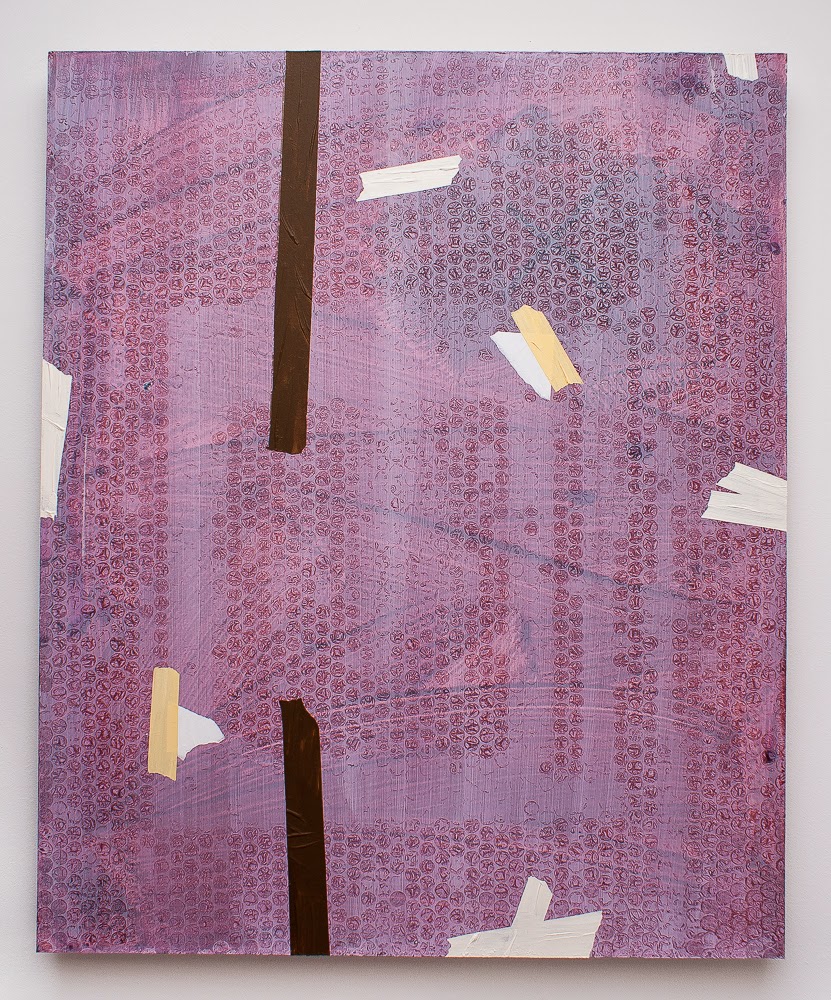
Years later, when I became a student at the art academy I realized that my own obsession with
abstract art started with this painting by Cézanne. Of course this is still more or less a figurative
painting, but it's far off from being a realistic view of the mountain. Later, after painting merely
pure abstract paintings, I started to incorporate figurative representations of things drawn from the
real world, things like tape and bubble-wrap, in order to make abstract paintings that play with the
associative character of the human brain. This is actually the mirror image of what Cézanne did
when he incorporated abstraction in his paintings, trying to come closer to the expreience of what you
see rather than being just another representation of what already exists.
Maarten van Soest, 2015

'I wished to copy nature. I could not. But I was satisfied when I discovered the sun, for instance, could not be reproduced, but only represented by something else'.
Paul Cézanne (1839-1906)


Maarten van Soest (NL)
No Title (Unpacked nr. 6)
2013
acrylic on MDF
60 x 50 cm


Maarten van Soest (NL)
No Title (Sawed nr. 1)
2012
acrylic on MDF
50 x 45 cm


Saturday, 9 May 2015

Joan Nelson / Thomas Moran


Thomas Moran (1837-1926)
Bridalveil Falls, Yosemite Valley
1904
oil on canvas
76,8 x 50,8 cm
Virginia Museum of Fine Arts, Richmond


Joan Nelson (US)
Untitled
2014
ink and spay paint and wax on wood panel
30,5 x 30,5 cm


Saturday, 25 April 2015

Josine Timmer / Claude Monet


Claude Monet
Water Lillies
1917-1920
100 x 300 cm
Musée Marmottan, Paris


I found it so difficult to choose. Many different artists crossed my mind, but finally I chose Monet. His later work I find fantastic. This work in particular, because of the sketchy character and the openness, and the 'swirl' and speed of the brush strokes.
Josine Timmer, 2015


Josine Timmer (NL)
Untitled
2014
watercolor and ink on paper
99 x 149 cm


Sunday, 19 April 2015

Simon Benson / Dante Alighieri - Sandro Botticelli


Dante Alighieri
The Divine Comedy
1308–21


Sandro Botticelli
The Chart of Hell (from the Drawings for Dante's Divine Comedy)
1480 -1495
coloured drawing on parchment
33 × 47,5 cm
Vatican Library, Rome


Simon Benson (UK/NL) 
The Dream Is Long (The Winding Path)
2014
graphite on paper
100 x 280 cm
www.simonbenson.nl